The Mitten Quest
Designed by
Cynthia Yoakum
Appropriate for Second Grade
Introduction
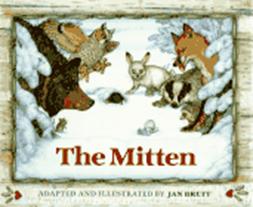
In the story The Mitten, Baba, made a new pair of mittens for her grandson, Nicki. Nicki asks his grandmother to knit him a pair of white mittens. Baba is afraid that white mittens will be hard to find outside in the snow. Nicki really wants white mittens and Baba finally knits his white mittens.
Baba was right and it wasn’t long before Nicki has dropped a mitten. Soon a mole discovers the mitten. It is warm and cozy and just the right size so he crawls inside. The mole is soon followed by a snowshoe rabbit, a hedgehog, an owl, a badger, a fox, a bear, and finally a mouse. All the animals fit into Nicki’s lost mitten.
You’re quest is to figure out which of the animals-a mole, a snowshoe rabbit, a hedgehog, an owl, a badger, a fox, a bear and a mouse –would fit into Nicki’s mitten. Would any of the animals fit? Would more than one animal fit in at one time? Which animal or animals could really live in a mitten?
The Task
We have read the book The Mitten by Jan Brett together in class, in groups of 4 you will:
- Trace, sew together and decorate a mitten using scissors, paper punch, yarn and decorative art supplies
- Look up the size of the 6 animals and create life size models on the drawing paper
- Write a story about what Nicki was doing after he dropped his mitten using the pictures from the mitten frame as a guide
- Find the words hidden in the snow word search puzzles
- Research information about how animal adapt to living in the cold and snow of winter
- Make masks of the animals and make a giant mitten and perform a play about The Mitten
- Research snow
- Make a chart of the weather and temperature for a week
The Process
Copies of the book The Mitten are located on the bookshelf if you need a copy to look at as you are on your quest.
Each student will be part of a group of 4 students who will work together on each activity. Each day you will move to a different activity until you have finished all the activities.
Activity 1 – Making Mittens
In the folder on the table you will find a pattern for a mitten. You will need to take a pattern and choose a piece of colored paper. At your desk, place the pattern on the colored paper making sure that you will be able to trace two copies of the pattern side by side. Trace the pattern 2 times. Using scissors cut out the 2 copies of the mitten that you have just traced. Place one mitten on top of the other with the thumbs both pointing in the same direction. Using the paper punch make holes ½ inch in from the edge. Do not punch any holes where you would put your hand in the mitten. Using the precut yarn, sew around the edges of the mitten. Tie the end of the yarn when you have finished.
Using the art materials available decorate both sides of your mittens.
Activity 2 – Life Size Animals
Your group is going to need to find out how big each of the animals from The Mitten will be when it is grown up. Using the computer will help you find the information you need. There are links for each of the animals which you can follow to get the size of the animal.
- Make a copy of the table below to record the size of the animals.
- Clink on the animal to follow the links to find out how big the animal will be when it is grown up. (Remember to look for the words inches to figure out size.) If there is more than one size listed for an animal, choose the smallest size given. Write the size in the table beside the animal name.
|
Animal |
Inches |
Will Animal Fit
(Yes or No) |
|
|
|
|
|
|
|
|
|
|
|
|
|
|
|
|
|
|
|
|
|
|
|
|
|
|
|
|
|
|
|
|
|
Your Hand |
|
|
- After you have recorded the size in the table, pick up the tape measure available and go to the paper roll. Using the tape measure, measure out and cut off a piece of paper that shows how long the animal would be grown up. Label the paper with the name of the animal. Also write the size of the animal on the paper. Also measure your hand and use the measurement to make a paper model. Hang up the papers showing the size of the animals and your hand.
- Compare the size of the animals and the size of your hand to decide if the animal will fit in the mitten. After you have decided, answer yes or no on the table.
Activity 3 – Write a Story
As a class reading the book, The Mitten, we talked about how the author Jan Brett uses page frames to show two scenes at once. Jan Brett has shown us two stories at one time. In the main picture frame you see one part of the story. In the mitten picture frame, you see what Nicki was doing while the animals were moving into the mitten he dropped. You are to write a story using the illustrations in the mitten picture frame. Remember that the mitten picture frames begin on the verso of the title page.
Activity 4 – Snow Word Search Puzzles
Each person in your group is to pick up one of the Snow Hidden Word Search Puzzles. The words you are to look for and circle when you have found them are listed at the bottom the sheet. Remember that the words may be written upside down and backwards. Cross each word off the list at the bottom as you find it.
Check your answers to see if you found them all correctly by clinking on this link, Snow Word Search 1 and Snow Word Search 2.
Look up in the dictionary any word that you do not know the meaning for.
Activity 5 – Animals in the Winter
Many animal habits change in the winter. You are to clink on the following computer links and read, “Animals in the Snow”, “Fun Fur Facts”, and “Snug in the Snow” to learn more about how animals adapt to live in the cold and snow of winter. Answer the questions on the sheet labeled for Activity 5 after you have read the information.
Activity 6 – Snow
The story The Mitten by Jan Brett takes place in what season of the year? What clues helped you?
Follow the links to learn more about one thing that makes winter different than other seasons. Clink on “Snow Facts” and “Snow Crystal Photographs” to learn more.
Evaluation
Teacher Rubric
|
Group Member |
1 Point |
2 Points |
|
Participation |
Each member was involved |
Each member offered ideas and cooperated with others |
|
Critical Thinking |
Stayed on task |
Verbalized ideas |
|
Writing |
Did the minimum |
Offered ideas and suggestions |
|
Artwork |
Did the minimum |
Used all resources creatively |
Conclusion
You have successfully completed your quest. You have measured the animals and figured out which animals would really fit into a mitten. Along the way you have also learned about snow and animal habits in the winter. Great Job!
North Carolina
Second Grade
Science
Strands: Nature of Science, Science as Inquiry, Science and Technology, Science in Personal and Social Perspectives
Competency Goal 2: The learner will build an understanding of the changes in weather.
2.01 Describe weather by measurable quantities: temperature, wind direction, wind speed, precipitation
2.02 Assess weather changes from day to day and over the seasons
Mathematics
Strands: Spatial Sense, Measurement and Geometry
Competency Goal 2: The learner will recognize, understand, and use basic geometric properties, and standard units of metric and customary measurement
2.06 Measure lengths in inches/centimeters; record results
2.09 Read Fahrenheit thermometers in increments of 1’s, 2’s, and 5’s; record results
Strands: Patterns, Relationships, and Functions
Competency Goal 3: The learner will demonstrate an understanding of classification, patterning and seriation.
3.06 Solve simple logic problems.
English
Strands: Oral Language, Written Language, and Other Media/Technology
Competency Goal 2: The learner will develop and apply strategies and skills to comprehend text that is read, heard, and viewed.
2.03 Read expository materials for answers to specific questions.
2.06 Recall facts and details from a text.
Competency Goal 4: The learner will apply strategies and skills to create oral, written, and visual texts.
4.06 Plan and make judgments about what to include in written products.
Credits and References
Books
Brett, Jan. The Mitten.
Computer Links
http://www.its.caltech.edu/~atomic/snowcrystals/photos/photos.htm
http://dnr.wi.gov/org/caer/ce/eek/nature/snugsnow.htm
http://library.thinkquest.org/3876/hardsearch.html
http://library.thinkquest.org/3876/easywsearch.html
http://dnr.wi.gov/org/caer/ce/eek/critter/bird/barredowl.htm
http://library.thinkquest.org/3876/snowfacts.html
http://www.dnr.state.wi.us/org/caer/ce/eek/critter/mammal/hare.htm
http://lsb.syr.edu/projects/cyberzoo/europeanhedgehog.html
http://library.thinkquest.org/3876/animalsinthesnow.html
http://encarta.msn.com/encyclopedia_761565627/Fox_(animal).html
http://encarta.msn.com/encyclopedia_761552686/Mole_(mammal).html
http://encarta.msn.com/encyclopedia_761578791/Badger.html
http://encarta.msn.com/encyclopedia_761569922/Mouse_(rodent).html
http://dnr.wi.gov/org/caer/ce/eek/critter/mammal/bears.htm
http://www.dnr.state.wi.us/org/caer/ce/eek/critter/mammal/fur.htm
http://www.janbrett.com/mitten_masks_main.htm
http://www.janbrett.com/biography.htm